Première monographie d'ampleur consacrée à l'œuvre textile d'Anni Albers : une vaste étude de la pratique et de la pensée d'une figure charnière entre deux continents et deux modernités.
The first major monograph on Anni Albers's textile work: a wide-ranging study of the practice and thought of a pivotal figure between two continents and two modernities.
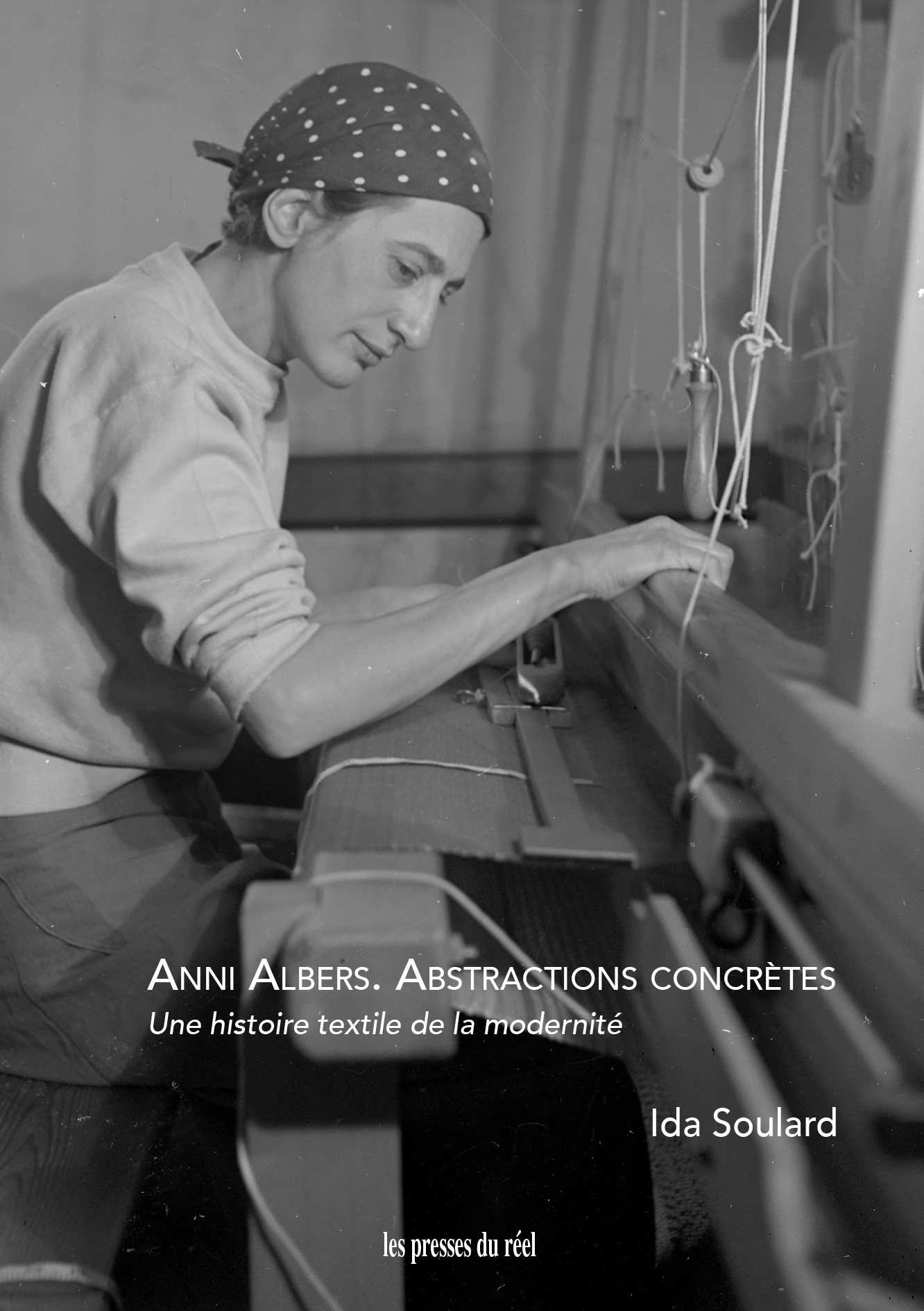
Born in Berlin in 1899, Anni Albers - artist, designer and educator - quickly encountered the gender prejudices prevailing in 1920s Germany. Yet she turned every constraint into a strength in the service of an art she dreamed of as timeless. Between two continents and two modernities, from the Bauhaus in Germany to Black Mountain College in the United States, she revolutionized the art of weaving and redefined the boundaries between art and design.
Née à Berlin en 1899, Anni Albers, artiste, designer et éducatrice, s'est rapidement heurtée aux préjugés de genre qui régnaient dans l'Allemagne des années 1920. Pourtant, elle sut tirer parti de toutes les contraintes pour en faire une force au service de la construction d'un art qu'elle rêvait intemporel. Entre deux continents et deux modernités, du Bauhaus, en Allemagne, au Black Mountain College aux États-Unis, elle a révolutionné l'art du tissage et redéfini les frontières entre l'art et le design.
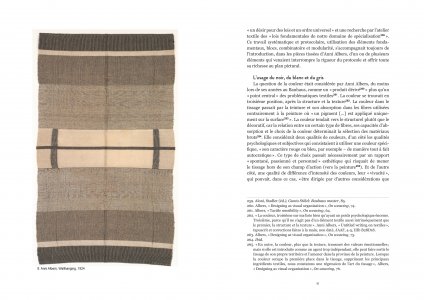
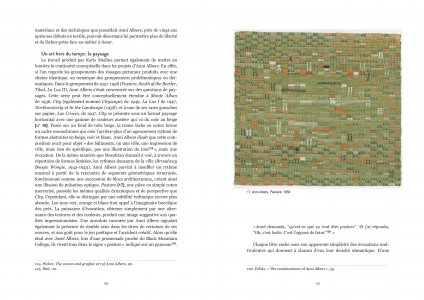
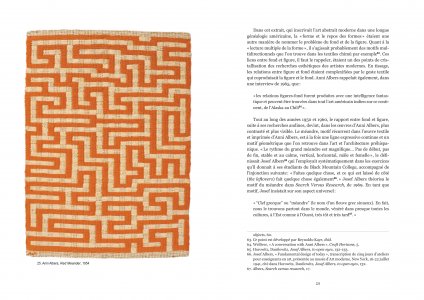
Still linked, at the beginning of the twentieth century, to women's work and what might be called a "feminine sensibility" - domestic craftsmanship, decorative and surface art - weaving practices rest on systems of rules and codes. Anni Albers invents a tactile-textile language, abstract, functional and sensual, that escapes traditional classifications.
Encore liées, au début du XXe siècle au travail des femmes et à ce qu'on pourrait nommer une « sensibilité féminine » - artisanat domestique, art d'ameublement, d'ornement et de surface - les pratiques de tissage reposent sur des systèmes de règles et de codes. Anni Albers invente un langage tactile-textile, abstrait, fonctionnel et sensuel, échappant aux classifications traditionnelles.
This first major monograph on Anni Albers's textile work offers a new perspective on the history of modern art through the lens of textile creation and practice. Why should we be interested today in this modern history of textile forms? Precisely because, in an era of profound cultural transformation, they offer a multiplicity of possible bifurcations and untaken historical paths.
Cette première monographie d'ampleur consacrée à l'œuvre textile d'Anni Albers apporte un point de vue nouveau sur une histoire de l'art moderne au prisme des créations et pratiques textiles. Pourquoi s'intéresser aujourd'hui à cette histoire moderne des formes textiles ? Précisément parce qu'à une époque de profondes transformations culturelles elles offrent une multiplicité de bifurcations possibles et de chemins historiques non empruntés.
"Abstractions concrètes goes beyond the simple rehabilitation of a textile artist. [...] Ida Soulard shows with great subtlety how Albers saw in weaving and in textility a 'method of approach' to the world rather than a mere medium."
Monica Seiceanu, Critique d'art
« Abstractions concrètes dépasse la simple réhabilitation d'une artiste textile. [...] Ida Soulard montre avec une grande finesse combien Albers voyait dans le tissage et dans la textilité une "méthode d'approche" du monde plutôt qu'un simple médium. »
Monica Seiceanu, Critique d'art
Anni Albers (1899–1994) was a textile artist, weaver, writer, teacher and lithographer whose work inspired a reconsideration of textiles as an artistic form - in their functional role, as freestanding wall hangings, and as pictorial weavings. Born Annelise Else Frieda Fleischmann in Berlin in 1899, she joined the Bauhaus weaving workshop in Weimar (1922–1925) and then in Dessau (1925–1932). The Alberses emigrated to the United States in 1933; Anni Albers directed the weaving workshop at Black Mountain College from 1933 to 1949. In 1949, she became the first textile artist to be given a solo exhibition at MoMA. She died in Orange, Connecticut, in 1994.
Anni Albers (1899–1994) est une artiste textile, tisserande, écrivaine, enseignante et lithographe ayant inspiré une reconsidération des textiles comme forme artistique dans leur rôle fonctionnel, en tant que tentures autonomes et en tant que tissages picturaux. Née Annelise Else Frieda Fleischmann à Berlin, en 1899, elle participe à l'atelier de tissage du Bauhaus à Weimar (1922–1925) puis à Dessau (1925–1932). Les Albers immigrent aux États-Unis en 1933 ; Anni Albers dirige l'atelier de tissage du Black Mountain College de 1933 à 1949. En 1949, elle devient la première artiste textile à bénéficier d'une exposition individuelle au MoMA. Elle meurt à Orange, dans le Connecticut, en 1994.
Par Ida Soulard
Les Presses du réel · Paru en octobre 2024 · 312 p. ill., 17 × 24 cm